
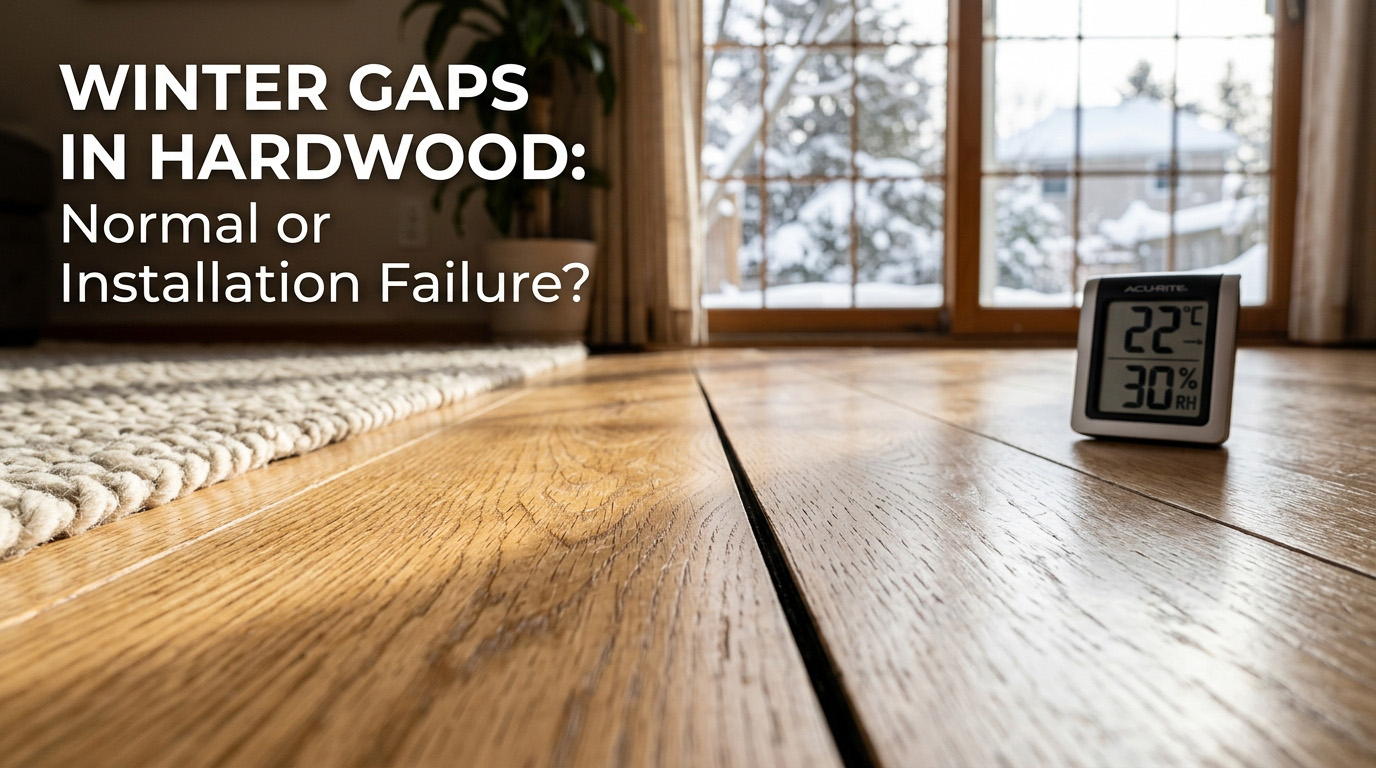
During the winter, many homeowners notice small gaps appearing between hardwood floorboards that were not visible during warmer months.
The immediate concern is often the same: Was the floor installed incorrectly?
Not necessarily.
Hardwood naturally expands and contracts as moisture levels change throughout the year. In New Jersey and throughout the Northeast, heated indoor air can become particularly dry during winter, causing hardwood to lose moisture and shrink slightly across its width.
Some winter gaps are completely normal. Others, however, may indicate improper acclimation, moisture problems, or installation issues.
Knowing the difference is important before deciding whether a floor actually needs repair.
Why Hardwood Floors Develop Gaps in Winter
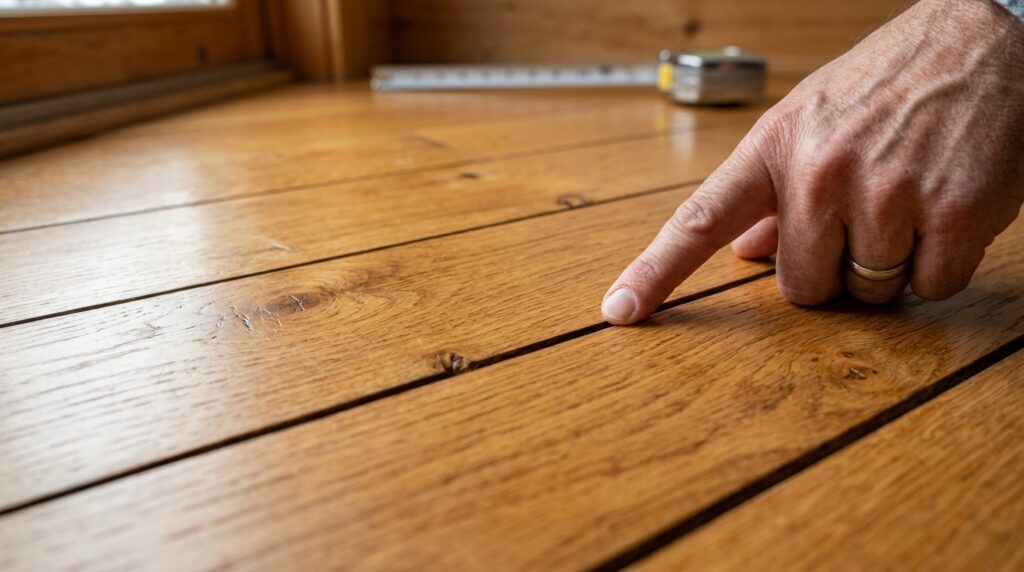
Hardwood is hygroscopic, meaning it absorbs and releases moisture in response to its environment.
During winter, heating systems often reduce indoor relative humidity. As the surrounding air becomes drier, hardwood releases moisture and contracts.
Because most dimensional movement occurs across the width of a board, small spaces can develop between neighboring planks.
When indoor humidity rises again, the boards typically absorb moisture and expand, causing many seasonal gaps to become smaller or disappear.
This natural cycle is expected with real hardwood.
What Do Normal Winter Gaps Look Like?
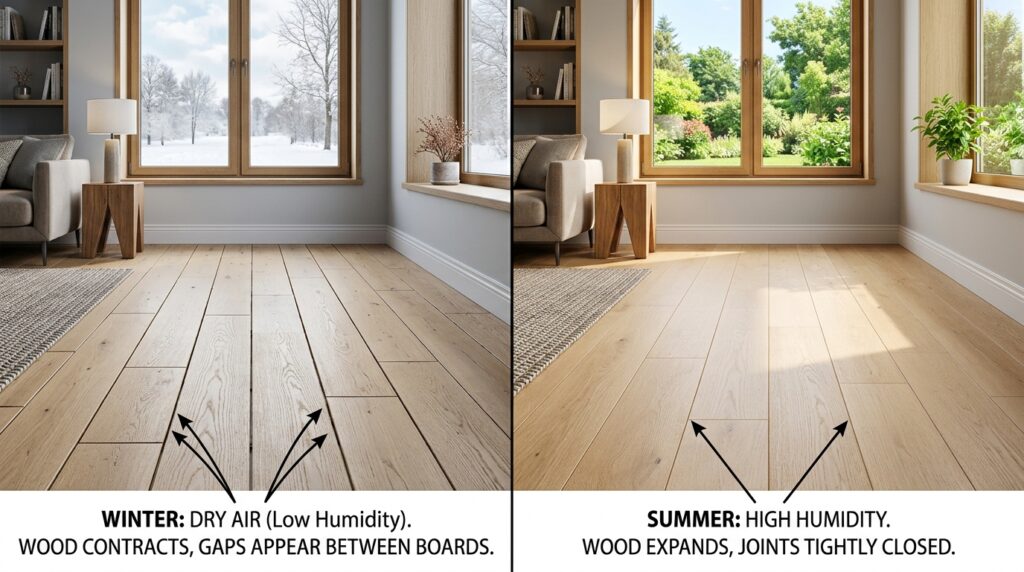
Seasonal shrinkage is generally less concerning when the gaps:
- Appear primarily during dry winter months
- Are relatively consistent throughout the floor
- Become smaller as humidity increases
- Are not accompanied by loose or moving boards
- Do not continue getting progressively worse year after year
The amount of movement varies from floor to floor.
Wood species, grain orientation, plank width, moisture content, indoor humidity, and installation conditions can all influence how noticeable winter gaps become.
Why Wide-Plank Floors Can Show More Movement
Plank width is an important factor that homeowners sometimes overlook.
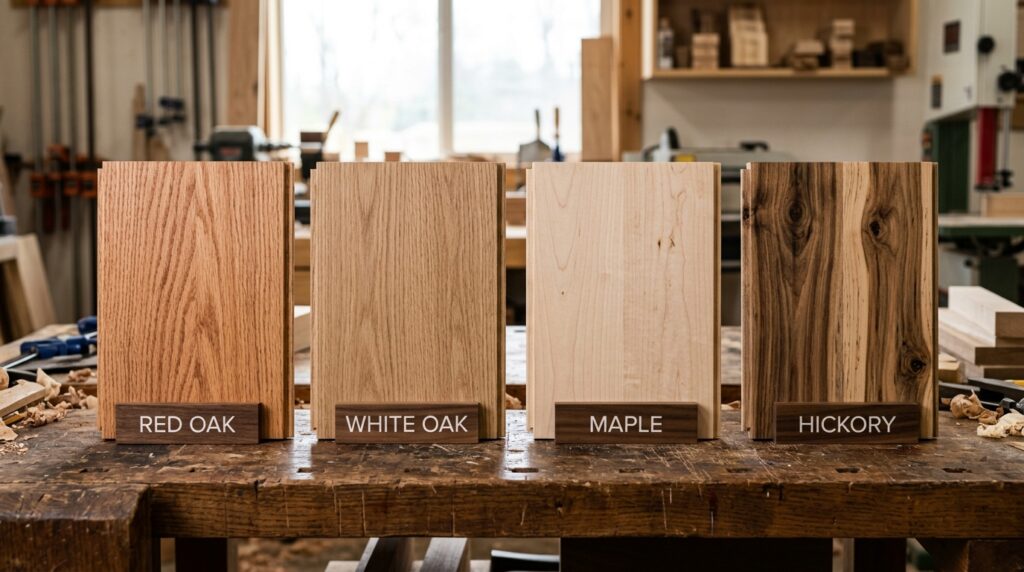
Because hardwood expands and contracts primarily across its width, wider solid hardwood boards can show more dimensional movement per board than narrower strip flooring under the same environmental changes.
That does not mean wide-plank flooring is defective or unsuitable.
It simply makes proper moisture management, acclimation, and installation especially important when working with wider material.
When Hardwood Gaps May Indicate a Problem
Not every gap should automatically be blamed on dry winter air.
A professional evaluation may be appropriate when:
- Large gaps remain throughout the year
- Gapping is concentrated in unusual or isolated areas
- Individual boards move underfoot
- Gaps continue becoming progressively larger
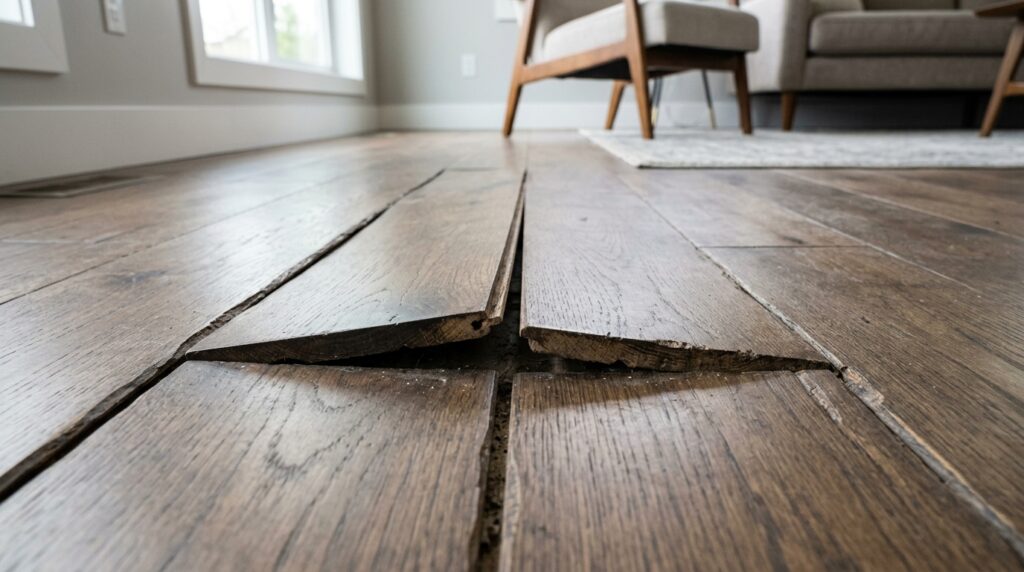
- The floor shows additional problems such as cupping, buckling, or significant squeaking
- The flooring has separated in ways that do not correspond with seasonal humidity changes
These conditions can indicate that something beyond normal seasonal movement is affecting the floor.
Improper Acclimation Can Contribute to Excessive Gapping
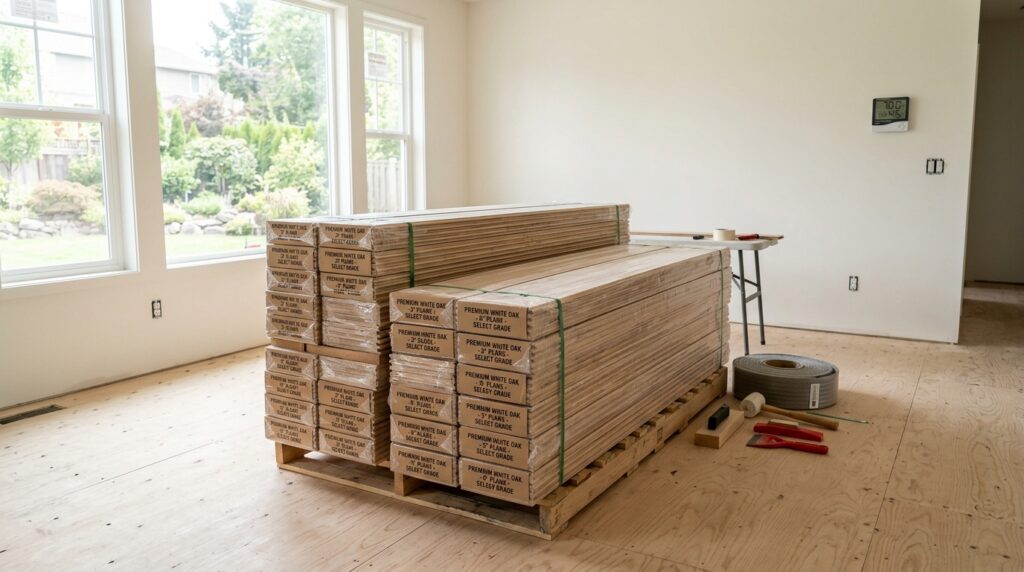
Hardwood should be installed only after the material and jobsite conditions meet the flooring manufacturer’s requirements.
Acclimation is not simply a matter of leaving flooring inside the house for a predetermined number of days.
Professional installers evaluate factors such as:
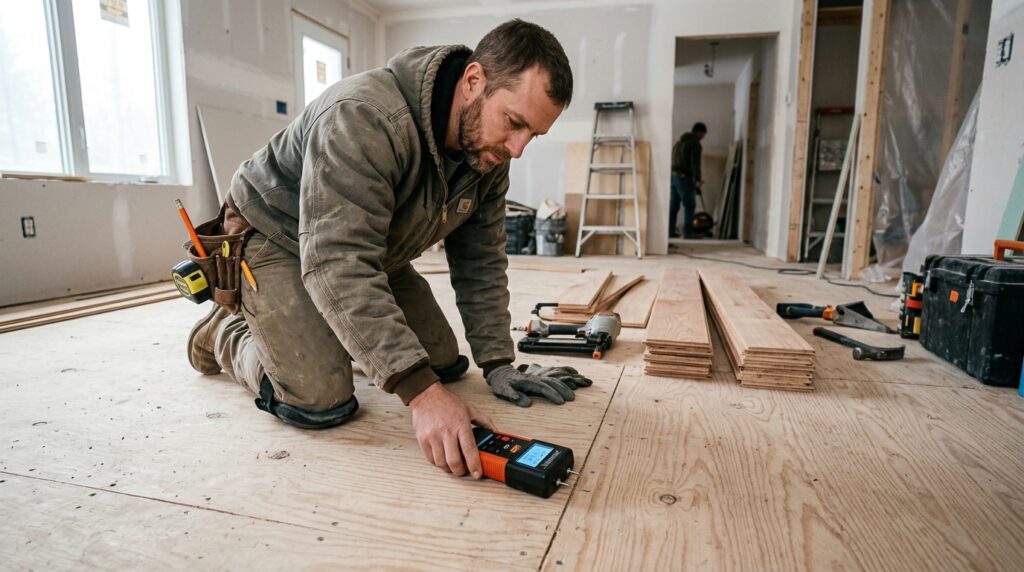
- Hardwood moisture content
- Subfloor moisture content
- Indoor relative humidity
- Temperature
- Manufacturer specifications
If hardwood is installed while its moisture content is significantly higher than the conditions it experiences later, excessive shrinkage can occur after installation.
This is one reason moisture readings are more useful than relying on a fixed acclimation timeline.
Subfloor and Moisture Conditions Matter Too
The condition beneath the hardwood also plays an important role in long-term stability.
Before installation, professionals may evaluate moisture conditions in plywood, concrete, or other approved subfloor systems using testing methods appropriate for the material and installation system.
Unexpected moisture conditions can contribute to uneven movement and other flooring problems.
This is also why a floor should never be evaluated based only on what is visible at the surface.
Indoor Humidity Is Often the Biggest Factor
A floor can be installed correctly and still develop seasonal gaps if indoor conditions change significantly.
Many hardwood flooring products are designed to perform within a relatively stable indoor humidity range. For many products, this is commonly around 35% to 55% relative humidity, although the flooring manufacturer’s specific requirements should always take priority.
When indoor air becomes excessively dry, hardwood can shrink more than expected.
Maintaining stable indoor conditions with appropriate HVAC operation and, when necessary, humidity control can significantly reduce seasonal movement.
How Professionals Determine Whether Gaps Are Normal
A professional flooring inspection should look beyond the width of an individual gap.
The evaluation may include:
- Measuring indoor relative humidity
- Testing hardwood moisture content
- Evaluating subfloor moisture conditions
- Checking whether boards are loose or moving
- Looking at the location and pattern of the gaps
- Reviewing the flooring type and installation method
- Determining whether the gaps change seasonally
We often see floors where homeowners assume winter gaps indicate installation failure, when the movement is actually consistent with dry indoor conditions.
We also see the opposite: gaps blamed on “normal seasonal movement” that remain year-round and point to a larger issue.
The pattern and underlying conditions matter more than the gap alone.
Should Winter Gaps Be Filled?

Usually, not immediately.
If gaps are caused by normal winter shrinkage, filling them while the flooring is contracted can create problems later when humidity rises and the boards expand again.
The first step should be determining why the gaps developed.
If the movement is seasonal, controlling indoor humidity may be all that is necessary.
If the gaps are persistent and related to installation, moisture, or isolated board problems, targeted repairs may be appropriate.
The solution should address the cause rather than simply hiding the visible gap.
Final Thoughts
Small gaps in hardwood flooring during a dry New Jersey winter do not automatically mean something went wrong during installation.
Real wood moves.
When indoor humidity falls, hardwood releases moisture and contracts. When humidity rises, it expands again. Some seasonal movement is a normal characteristic of a natural hardwood floor.
What deserves attention is gapping that remains year-round, becomes progressively worse, appears alongside movement or other flooring problems, or does not correspond with seasonal conditions.
A professional inspection can determine whether the floor is experiencing normal dry-air shrinkage or whether moisture conditions, acclimation, or installation issues are contributing to the problem.
Understanding the cause before attempting a repair is the best way to protect the appearance, stability, and long-term performance of the hardwood floor.
Request a consultation:
renovaflooring.com
Visit our website for more inspiration and design ideas!